Korean Insurance Market
1. Preliminary Business Results of Insurers for 2024
In 2024, total premium income for the Korean insurance industry - comprising 22 life insurers and 32 non-life insurers - stood at KRW 241.04 trillion, up KRW 3.44 trillion (+1.4%) from the same period a year earlier.
Premium Income (Unit: KRW billion, %)
| Category | 2023 | 2024 | Change (%) |
|---|
| Life Insurers | 112,407.5 | 113,440.0 | 0.9 |
|---|
| Protection | 48,636.4 | 55,024.2 | 13.1 |
|---|
| Savings | 28,051.4 | 28,798.6 | 2.7 |
|---|
| Variable | 12,223.6 | 12,274.2 | 0.4 |
|---|
| Retirement Annuity, etc. | 23,496.1 | 17,343.0 | -26.2 |
|---|
| Non-Life Insurers | 125,201.7 | 127,604.5 | 1.9 |
|---|
| Long-term | 66,211.9 | 69,686.3 | 5.2 |
|---|
| Motor | 21,121.1 | 20,741.5 | -1.8 |
|---|
| General P&C | 13,852.7 | 14,881.6 | 7.4 |
|---|
| Retirement Annuity, etc. | 24,016.0 | 22,295.1 | -7.2 |
|---|
| Total | 237,609.2 | 241,044.5 | 1.4 |
|---|
The total net income of all insurance companies amounted to KRW 14.14 trillion, an increase of KRW 628.2 billion (+4.6%) compared to the previous year.
Net Income (Unit: KRW billion, %)
| Category | 2023 | 2024 | Change (%) |
|---|
| Life Insurers | 5,263.8 | 5,637.4 | 7.1 |
|---|
| Non-Life Insurers | 8,252.0 | 8,506.6 | 3.1 |
|---|
| Total | 13,515.8 | 14,144.0 | 4.6 |
|---|
(Source: Financial Supervisory Service, March 25, 2025)
< ROA and ROE > (Unit: %)
| Metric | Category | 2023 | 2024 | Change (%p) |
|---|
| ROA | Life Insurers | 0.60 | 0.63 | 0.03 |
|---|
| Non-Life Insurers | 2.40 | 2.39 | -0.01 |
|---|
| Total | 1.10 | 1.13 | 0.03 |
|---|
| ROE | Life Insurers | 5.02 | 6.03 | 1.01 |
|---|
| Non-Life Insurers | 13.05 | 13.81 | 0.76 |
|---|
| Total | 8.04 | 9.12 | 1.08 |
|---|
< Total Assets and Shareholders’ Equity > (Unit: KRW trillion)
| Metric | Category | Dec 2023 | Dec 2024 | Change (%) |
|---|
| Total Assets | Life Insurers | 882.6 | 905.5 | 2.6 |
|---|
| Non-Life Insurers | 343.7 | 367.7 | 7.0 |
|---|
| Total | 1,226.3 | 1,273.2 | 3.8 |
|---|
| Total Liabilities | Life Insurers | 777.7 | 823.5 | 5.9 |
|---|
| Non-Life Insurers | 280.5 | 307.7 | 9.7 |
|---|
| Total | 1,058.2 | 1,131.2 | 6.9 |
|---|
| Shareholders’ Equity | Life Insurers | 104.9 | 82.1 | -21.7 |
|---|
| Non-Life Insurers | 63.2 | 60.0 | -5.1 |
|---|
| Total | 168.1 | 142.1 | -15.5 |
|---|
In summary, insurers’ net income increased year on year despite rising insurance claims payments, supported by improved interest and dividend income driven by a growth in invested assets. However, shareholders’ equity declined as insurance liabilities expanded due to falling interest rates and more conservative discount-rate assumptions.
Korean Insurance Market
2. K-ICS Ratios of the Korean Insurance Industry as of Late Dec 2024
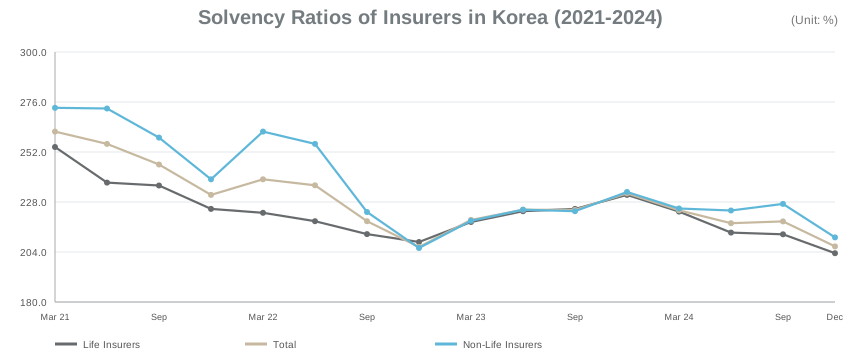
As of end-2024, after the application of transitional measures, insurers’ solvency ratio (K-ICS ratio) declined to 206.7%, down 11.6%p from 218.3% in the previous quarter. Life insurers recorded 203.4%, while non-life insurers stood at 211.0%.
The main factors behind the change were a decline in available capital by KRW 10.8 trillion and a KRW 1.4 trillion increase in required capital. Available capital after transitional measures stood at KRW 248.1 trillion, while required capital rose to KRW 120.0 trillion.
< K-ICS Ratios and Impacts from Transitional Measures (as of Late Dec. 2024) >
| Classification | Q3 2024
Before | Q4 2024
Before | Change | Q3 2024
After | Q4 2024
After | Change |
|---|
Available Capital
(KRW trillion) | 256.0 | 245.2 | -10.8 | 258.9 | 248.1 | -10.8 |
|---|
Required Capital
(KRW trillion) | 126.3 | 128.2 | +1.9 | 118.6 | 120.0 | +1.4 |
|---|
K-ICS Ratio
(%, %p) | 202.7 | 191.3 | -11.4 | 218.3 | 206.7 | -11.6 |
|---|
(Source: Financial Supervisory Service, Insurance Companies’ Capital Adequacy Ratios under K-ICS, December 2024, Press Release dated May 15, 2025)
Given the decline in the risk-based capital ratio, insurers are expected to maintain sufficient high-quality capital while enhancing risk management practices to strengthen their medium- to long-term solvency.
Korean Insurance Market
3. Review of Insurers’ Overseas Operations for 2024
As of the end of 2024, a total of 11 insurance companies - 4 life insurers and 7 non-life insurers - were operating 44 overseas branches across 11 countries, up from 42 at the end of 2023.
Overseas Presences of Korean Insurers (Unit: No. of operations)
| Category | 2023 | 2024 | Change |
|---|
| Subsidiary | Branch | Total | Subsidiary | Branch | Total | Subsidiary | Branch | Total |
|---|
| Life Insurers | 11 | - | 11 | 11 | - | 11 | - | - | - |
|---|
| Non-Life Insurers | 20 | 11 | 31 | 22 | 11 | 33 | +2 | - | +2 |
|---|
| Total | 31 | 11 | 42 | 33 | 11 | 44 | +2 | - | +2 |
|---|
Net income from overseas operations recorded a profit of USD 159.1 million, representing a turnaround from a loss of USD 14.3 million in the previous year.
Net Income for Overseas Business Operations of Korean Insurers (Unit: USD million)
| Category | 2023 | 2024 | Change |
|---|
| Life Insurers | 61.8 | 64.0 | +2.2 |
|---|
| Non-Life Insurers | -76.1 | 95.1 | +171.2 |
|---|
| Total | -14.3 | 159.1 | +173.4 |
|---|
Financial Position of Overseas Business Operations (Unit: USD billion)
| Category | 2023 | 2024 | Change |
|---|
| Assets | 6.42 | 7.34 | +0.92 |
|---|
| Liabilities | 3.42 | 3.97 | +0.55 |
|---|
| Equities | 3.01 | 3.37 | +0.36 |
|---|
(Source: Financial Supervisory Service, May 7, 2025)
Korean Insurance Market
4. Performance of Motor Insurance Business for 2024
In 2024, motor insurance direct premiums written totaled KRW 20.66 trillion, down KRW 384.3 billion (-1.8%) from the previous year’s KRW 21.05 trillion. The four major insurers - Samsung, Hyundai, KB, and DB - maintained an 85.3% market share.
Trends in Motor Insurance Market Share
| Category | 2020 | 2021 | 2022 | 2023 | 2024 | Change |
|---|
| Major Insurers (4) | 84.7% | 84.7% | 84.9% | 85.3% | 85.3% | - |
|---|
| Mid-to-Small Insurers (5) | 10.0% | 9.4% | 8.9% | 8.4% | 8.3% | -0.1%p |
|---|
| Non-face-to-face Specialist Insurers (3) | 5.3% | 5.9% | 6.2% | 6.3% | 6.4% | +0.1%p |
|---|
By distribution channel, face-to-face sales accounted for 47.8%, followed by cyber marketing (CM) at 35.8%, telemarketing (TM) at 16.0%, and platform marketing (PM) at 0.4%.
Trends in Motor Insurance Distribution Channels
| Channel | 2020 | 2021 | 2022 | 2023 | 2024 | Change |
|---|
| Face-to-face | 53.0% | 51.7% | 50.4% | 49.7% | 47.8% | -1.9%p |
|---|
| CM | 28.6% | 31.0% | 33.1% | 33.8% | 35.8% | +2.0%p |
|---|
| TM | 18.4% | 17.3% | 16.5% | 16.5% | 16.0% | -0.5%p |
|---|
| PM | - | - | - | - | 0.4% | - |
|---|
In 2024, the motor insurance segment recorded an underwriting loss of KRW 97 billion, as the combined ratio reached 100.1%, exceeding the break-even point.
Trends in Motor Insurance Loss Ratio and Expense Ratio
| Ratio | 2020 | 2021 | 2022 | 2023 | 2024 | Change |
|---|
| Loss Ratio | 84.4% | 81.5% | 81.2% | 83.7% | 83.8% | +0.1%p |
|---|
| Expense Ratio | 16.6% | 16.3% | 16.2% | 16.4% | 16.3% | -0.1%p |
|---|
(Source: Financial Supervisory Service, April 7, 2025)
Korean Insurance Market
5. Impact of Climate Change on Life Insurance
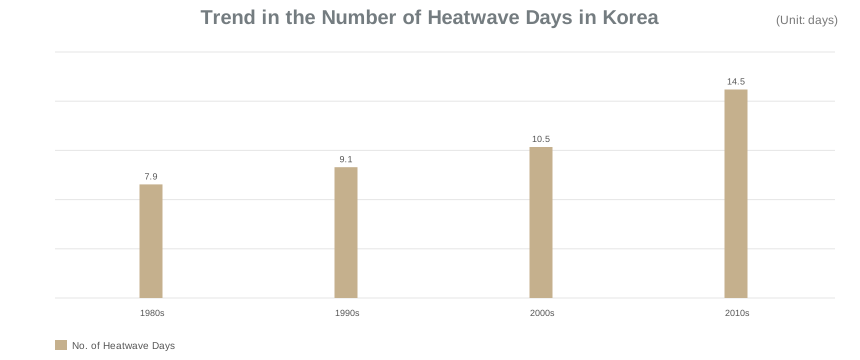
Korea has seen a steady rise in extreme heatwave days due to overall temperature increases. During the 1980s the average annual number of extreme heat days was 7.9, rising to 14.5 days in the 2010s. Looking ahead, Korea’s average annual temperature in the latter half of the 21st century is projected to rise by 2.3°C to 6.3°C compared with the 2000-2019 baseline, depending on greenhouse gas emissions.
Climate change poses a growing threat to human health and safety worldwide, driven by rising temperatures, worsening air pollution, and increasingly frequent extreme weather events.
Impact of Climate Change on Health
| Health Impact | Air Pollution | Extreme Temperatures & Precipitation | Natural Disasters | Water Supply Shortages | Ecological Change |
|---|
| Cardiovascular Diseases | Strong | Strong | Moderate | - | - |
|---|
| Respiratory Diseases | Strong | Strong | Moderate | - | - |
|---|
| Vector-borne Diseases | - | Moderate | - | - | Strong |
|---|
| Severe Injuries | - | - | Strong | - | - |
|---|
| Mental Health Disorders | Moderate | Moderate | Strong | - | - |
|---|
| Malnutrition | - | - | - | Strong | Moderate |
|---|
| Gastrointestinal / Waterborne Diseases | - | Moderate | Moderate | Strong | Moderate |
|---|
(Source: Korea Insurance Research Institute, 2024)
The World Health Organization projects that, between 2030 and 2050, climate change could lead to approximately 250,000 additional deaths per year from causes such as malnutrition, malaria, diarrhea, and heat stress. Life insurers may therefore face increased claims under health and life insurance policies.
Analysis of Climate Change Impact on Life Insurance Claims
| Climate Variable | Disease Group | Hospitalization Coverage | Death Coverage |
|---|
| Monthly Highest Temperature | Infectious Diseases | No clear correlation | Positive impact |
|---|
| Cardiovascular / Cerebrovascular Diseases | Positive impact | Positive impact |
|---|
| Heat-related Illnesses | Positive impact | - |
|---|
These findings highlight the need for integrated climate and health data analysis, climate-reflective pricing, shorter renewal cycles where appropriate, hybrid products, consumer education and inclusive-finance measures.
Korean Insurance Market
6. Forest Insurance as a Climate Adaptation Measure to Mitigate Wildfire Risks
Global warming and other climate change phenomena contribute to rising average temperatures and drier atmospheric conditions, increasing wildfire risk. In Korea, the number of dry weather advisories during spring and winter continues to rise while both the volume and frequency of precipitation are declining.
Dry Weather Advisory Issuance over the Past 10 Years
| Category | 2015 | 2016 | 2017 | 2018 | 2019 | 2020 | 2021 | 2022 | 2023 | 2024 |
|---|
| No. of Issuances | 19 | 16 | 16 | 9 | 18 | 16 | 14 | 14 | 16 | 11 |
|---|
| Number of Days | 120 | 117 | 158 | 118 | 158 | 154 | 121 | 149 | 136 | 78 |
|---|
(Source: Korea Forest Service, 2024 Wildfire Statistics Yearbook)
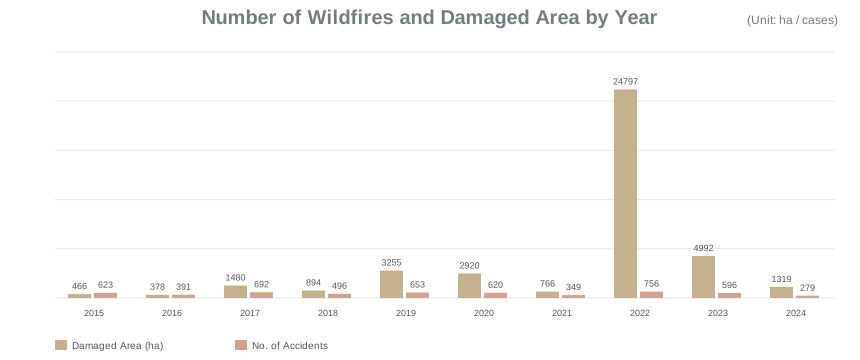
Over the past 10 years, there have been 5,455 wildfires in Korea, resulting in damage to 40,032ha of land - an annual average of 546 cases and approximately 4,000 hectares affected per year. In 2022 alone, there were 756 wildfires, causing damage to 24,797ha.
Among the 38 OECD member countries, Korea ranks fourth in terms of forest area as a percentage of total land area, with forests covering 62.6% of its territory. Although forests provide significant economic value, there is still no comprehensive insurance product in place to systematically cover the economic risks caused by wildfires.
Japan, China, France and Finland operate forest insurance arrangements using combinations of standardized insured values, premium subsidies, actual-loss compensation and coverage for fire and climatic disasters. Korea has government-driven natural disaster insurance programs for crops, aquaculture and other natural perils, but forest insurance has yet to be introduced.
As global warming progresses and the scale of forest fire damage continues to expand, government-driven insurance arrangements for forest fires will be increasingly important for both preventive risk management and effective compensation. Objective standards such as standardized insured values for timber and regional risk statistics will be necessary to establish a sustainable forest disaster insurance system.
[1] From natural disasters such as Typhoon Mawar in Guam (May 2023) and the wildfires in Maui, Hawaii.
[2] Growth Rate of Insured Vehicles: 2.4% (2022), 2.5% (2023), and 0.9% (2024).
[3] Average Motor Insurance Premium Reduction Over the Past Three Years: -1.2% (2022), -1.9% (2023), and -2.5% (2024).
[4] Non-face-to-face Specialist Insurer: A company whose sales are predominantly generated through non-face-to-face distribution channels such as TM and CM.
[5] TM: Telemarketing, CM: Cyber Marketing, PM: Platform Marketing.
[6] Combined Ratio: The sum of the loss ratio and expense ratio.